Why Denver Homeowners Are Replacing Concrete Driveways With Porous Pavers
Why Denver Homeowners Are Replacing Concrete Driveways With Porous Pavers
The driveway ran 130 feet, and after years of freeze and thaw, the concrete had cracked and heaved past the point of repair. What the crew found underneath was worse, a layer of what the homeowner would later call "a nightmare of notorious wet clay."
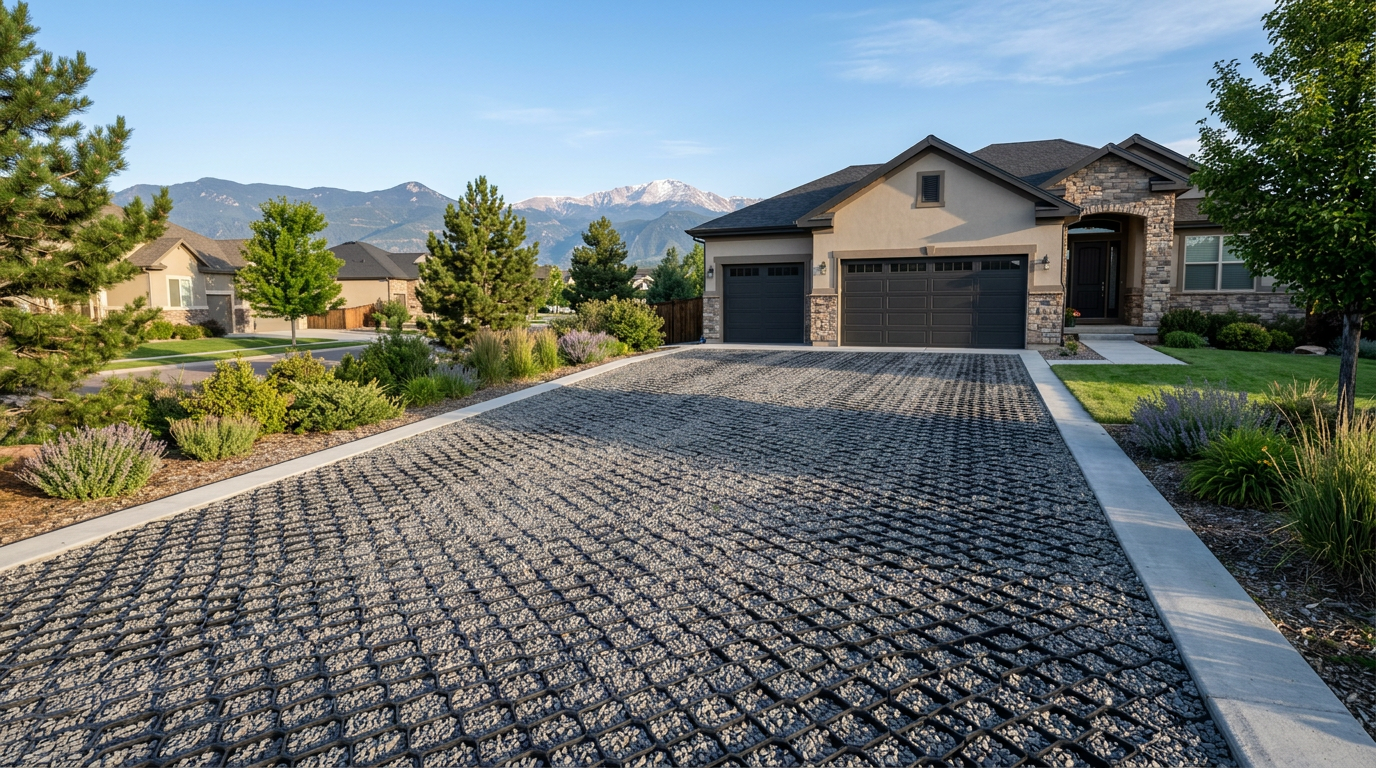
His replacement surface was not more concrete. It was TrueGrid, a porous paver system: interlocking grids filled with gravel, built to carry the weight of daily parking while letting water pass straight through. The conversion stripped out 1,800 square feet of impervious surface and left behind a driveway that lets rain and snow soak back into the ground instead of sheeting toward the street and the foundation.
The project, handled by Grade A Excavation & Landscape of Northglenn, is a window into a quiet shift in how Front Range homeowners treat hard surfaces. With the metro under Stage 1 drought restrictions and clay soil that punishes rigid slabs, permeable driveways are moving from niche product to practical choice.
Why concrete fails on Denver's clay
Start with the soil. Much of the Denver metro sits on heavy clay, and clay absorbs water slowly. During a storm, surface water collects instead of soaking in. A concrete slab above it takes the punishment year after year: water works into every hairline crack, freezes overnight, expands, and lifts the surface a little more. Homeowners know the end state as the cracked, heaving slab that no patch seems to fix.
By the time a driveway looks like that, the problem is usually not the concrete. It is what is underneath: saturated ground, a settling base, and drainage with nowhere to go. That is what the Grade A crew found when they opened up the 130-foot driveway. Wet clay, the kind that makes every stage of the below-ground work a slow fight.
How a porous paver driveway actually works
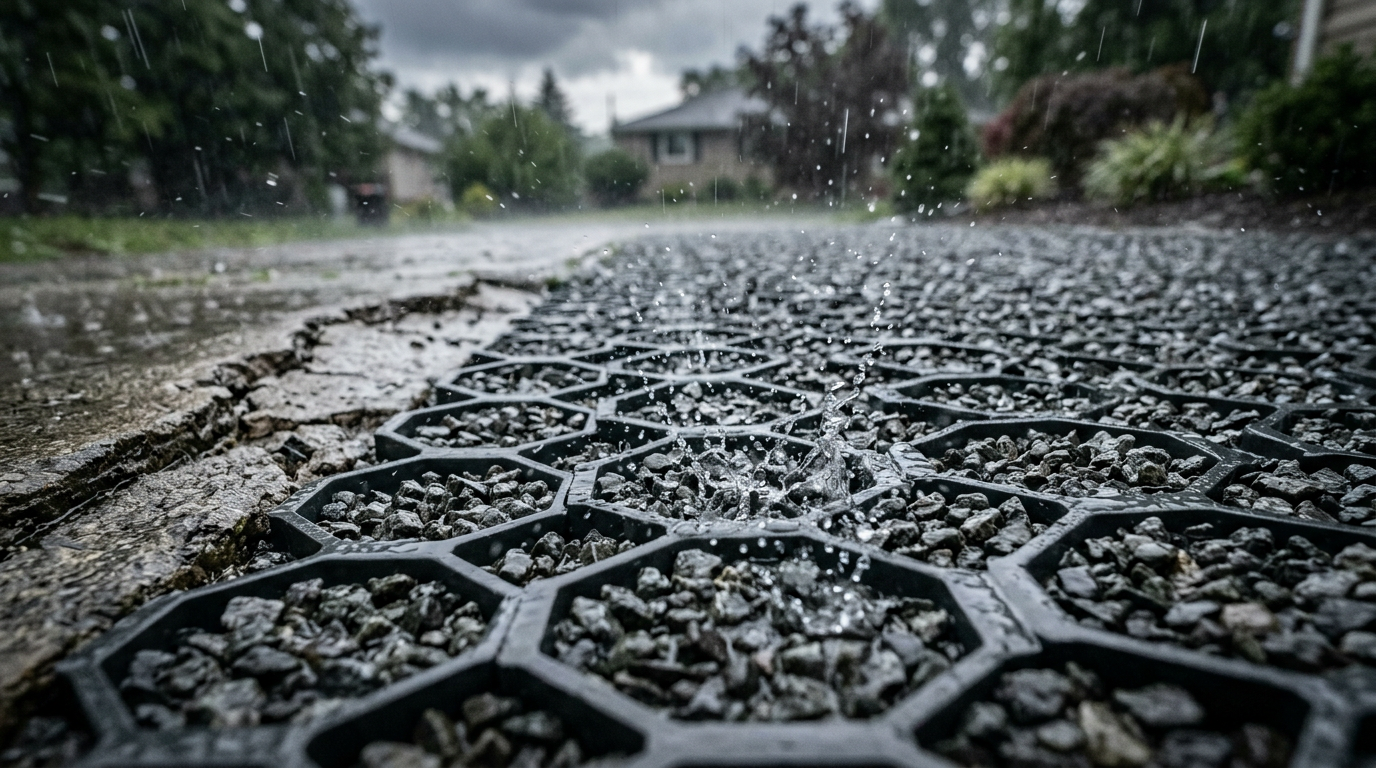
A permeable driveway is a system, not a surface. The visible part is a grid, in this case TrueGrid, laid over a prepared base and filled with gravel. The cells lock the gravel in place so the driveway stays stable under daily parking and winter shoveling, while the open structure lets water drain through the surface and percolate into the ground below.
The drainage benefits compound. Water that would have run off a slab toward the garage, the sidewalk, or the foundation instead enters the soil on site. During a wet spring or a fast melt, that is less water pressing on the foundation wall, which is where Grade A's business started in the first place. The company has spent more than 20 years on foundation drainage, and a permeable surface is one more way to keep water moving where it should.
Another Grade A customer, Susan Massey, described her version of the system in a review as "an open grid drive-over paving system with gravel fill," installed as part of a larger project that included re-grading the yard, removing a long concrete driveway, adding a trench drain, a lawn with mulched borders, and a 14-zone well-water irrigation system. The common thread: the driveway was treated as one piece of the yard's water handling, not a standalone pour.
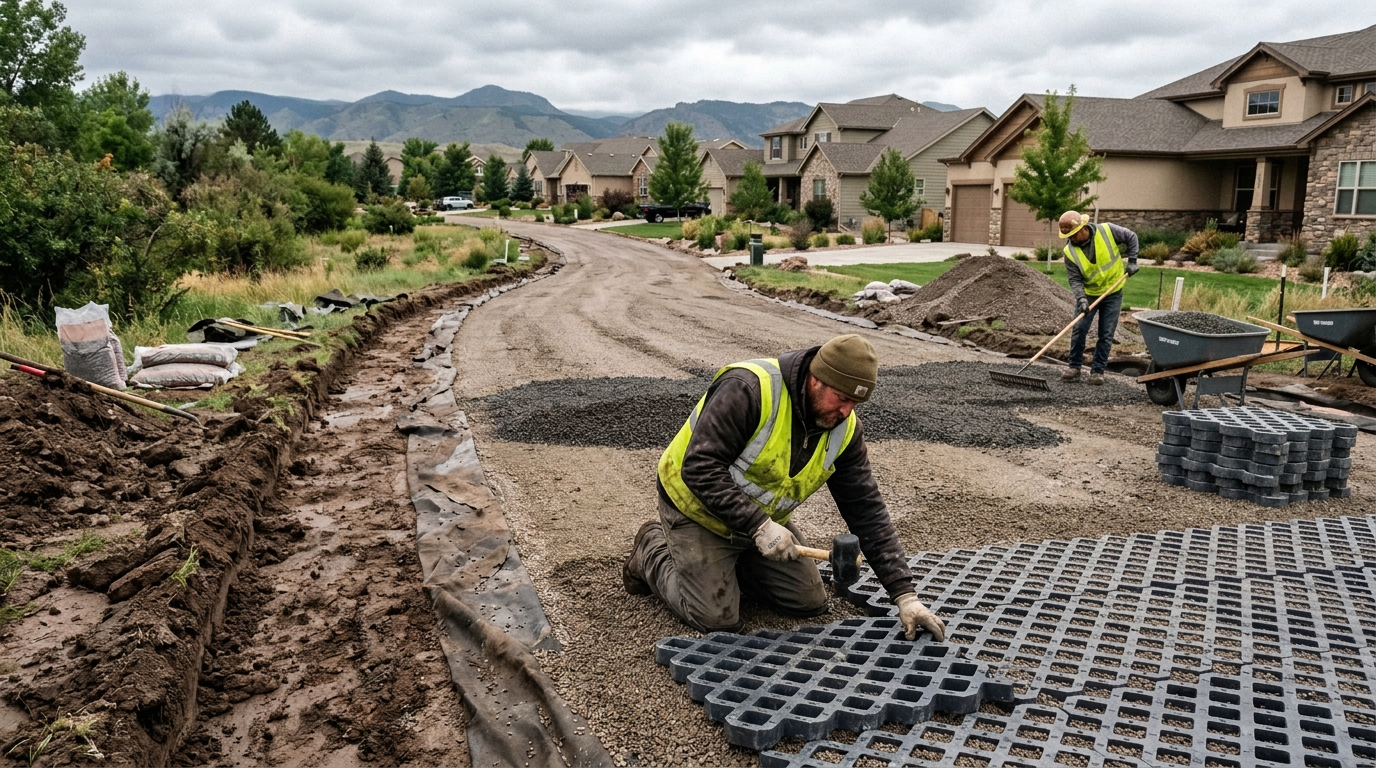
The 130-foot driveway, from nightmare to finished surface
The review describing the TrueGrid project, posted this fall, laid out the job in unusual detail. A 130-foot concrete driveway, cracked and heaving. Wet clay underneath. As best as the customer could tell, Grade A is the only TrueGrid certified installer in the Denver metro region.
The crew, he wrote, "worked tirelessly to overcome the daunting problems thrown at them by this muck." He named the crew members, Kevin, Isaac, and Luis, and closed with the line that matters most to anyone considering the same project: "The end product not only looks amazing, we feel so much better about removing 1,800 sq ft of impervious concrete and having a driveway which will allow rain and snow to percolate back into the ground."
Two things stand out in that account. First, the difficult part of a porous paver driveway is not the pavers. It is the tear-out, the base preparation, and the drainage work below, which is why the contractor matters more than the product. A grid laid over the same wet clay that ruined the concrete will not perform any better. Second, the water math is real: nearly 2,000 square feet that used to shed every drop now absorbs it on site.
One crew, the whole yard
Hugh Mathews, who owns Grade A, describes the company's advantage in a single line: "You're getting two for one from me, a drainage expert and a landscaper." Since the 2013 floods, much of the company's work has focused on correcting drainage problems before they become structural ones, and that dual expertise shapes how paver projects get built.
For homeowners, the practical effect shows up as bundling. Massey's project folded the driveway, the trench drain, the re-grade, and the irrigation into one mobilization. In another review, a pool removal client added front yard improvements while the crew was already on site, by choice, and called the results fantastic. When the crew is already there, fixing the slope or adding drainage while the grids go in is the cheap version of the work, and the yard ends up functioning as one system.
What to know before you dig
A few honest points before swapping concrete for grid.
The look is different. A filled grid driveway is gravel textured, not a smooth gray slab. Homeowners who want the appearance of fresh poured concrete will not find it here. What they get instead is a surface suited to Colorado's soil and water realities.
The base is the job. Wet clay, limited access, or a slope all raise the difficulty. The TrueGrid project succeeded because the crew solved the subgrade first. The product cannot do that part on its own.
The assessment comes first. Grade A begins with a free estimate and an evaluation of drainage, grade, and soil conditions before recommending a solution.
Timing can pay. Estimates approved between October and February carry 10% off the project, which makes the slow season the affordable season for this kind of work.
The bottom line
Mathews' prevention message from a recent winter-preparation feature applies to driveways as much as downspouts: "Most people only call when there's a problem. But prevention is worth so much more than waiting until there's already a problem."
A cracked slab over wet clay is already a problem. A permeable replacement, built on a properly prepared base with drainage engineered around it, is the version that keeps water out of the foundation and puts it back in the ground.
Homeowners in the Denver metro can call Grade A Excavation & Landscape at (720) 263-2001 for a free estimate, or visit the contact page to schedule an assessment.
Grade A Excavation & Landscape
Protecting Denver Metro homes for more than 20 years.
